Artificial intelligence is rapidly reshaping call centers from cost centers into high-performing, customer-focused engines for growth. By combining human empathy with machine intelligence, modern contact centers can respond faster, personalize every interaction, and unlock insights that were previously impossible to see. Today, AI conversational voice bots - bot de voz conversacional con IA and other AI tools every modern business needs are helping redefine what artificial intelligence in contact centers can achieve, making customer experiences smarter, faster, and more efficient.
This guide walks through what artificial intelligence in call centers really means, the key benefits, common use cases, and practical steps to get started.
Transforming Call Centers with Cloud-Based AI Solutions
Modern call centers are increasingly leveraging cloud-based AI solutions to handle vast volumes of customer interactions seamlessly. These platforms allow businesses to scale quickly, store and analyze data securely, and deploy AI conversational voice bots without heavy infrastructure costs. Cloud-based AI ensures that agents can access real-time insights from anywhere, improving response times and enhancing overall customer satisfaction.
Advances in Intelligent Computing Systems
The backbone of AI-powered call centers lies in intelligent computing systems. These technologies process massive datasets to predict customer needs, automate repetitive tasks, and assist agents in delivering personalized support. By integrating AI with traditional computer technology, contact centers can turn raw data into actionable intelligence, making every customer interaction more informed and efficient.
Boosting Customer Engagement with AI-Driven Marketing Tools
AI is transforming the way call centers contribute to business growth through AI-driven marketing tools. By analyzing past interactions, preferences, and behavior patterns, these tools help agents provide targeted offers, recommend products, and retain customers more effectively. Marketing efforts become smarter and more personalized, aligning perfectly with the goals of modern customer experience strategies.
Streamlining Promotions with Automated Marketing Intelligence
Beyond general marketing, automated marketing intelligence allows call centers to optimize campaigns and predict outcomes before launching them. Integrating AI into marketing operations reduces guesswork, increases conversion rates, and enables agents to respond proactively to customer needs. This seamless connection between AI and marketing ensures a consistent, high-quality customer experience across all touchpoints.
Enhancing Financial Operations with AI Insights
Call centers also benefit from AI financial insights by streamlining billing, detecting fraud, and forecasting customer payment behaviors. These tools help businesses make smarter financial decisions and provide agents with the information needed to guide customers through complex transactions efficiently. AI in financial operations ensures accuracy, reduces risk, and improves overall trust in the customer relationship.
What Is Artificial Intelligence in Call Centers?
Artificial intelligence in call centersrefers to the use of technologies such as machine learning, natural language processing, and automation tools to assist both customers and agents across voice and digital channels.
Instead of replacing people, AI acts as a powerful assistant that can:
- Understand customer intent from voice or text in real time.
- Provide instant answers to common questions via virtual agents.
- Guide human agents with suggested responses and next best actions.
- Analyze large volumes of calls and messages for trends and insights.
The result is a smarter, faster, and more consistent customer experience.
Leading AI Call Center Platforms Transforming Customer Experience
Here’s a list of the top platforms driving innovation in artificial intelligence in call centers today:
- Bright Pattern
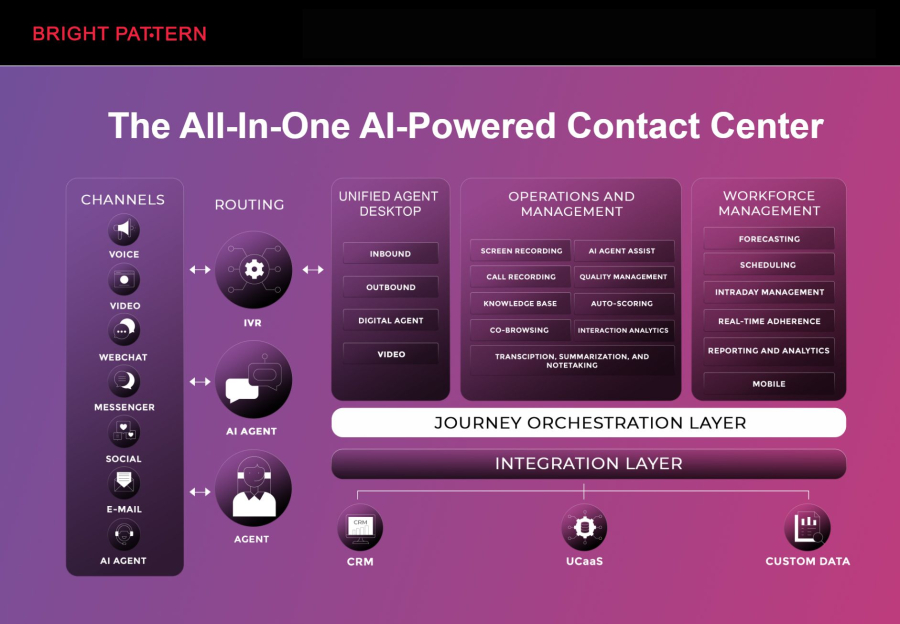
Bright Pattern stands out as a leader in AI-powered call center solutions, combining AI conversational voice bots with advanced analytics, omnichannel support, and cloud scalability. Its intuitive interface empowers agents to handle calls, chats, emails, and social media interactions seamlessly, while AI tools every modern business needs help managers track performance and optimize workflows. Bright Pattern also offers robust integrations with CRM platforms and third-party applications, enabling businesses to unify customer data for personalized experiences. The platform’s AI capabilities extend to predictive routing, real-time sentiment analysis, and automated follow-ups, ensuring customers are always engaged efficiently. With a focus on both operational efficiency and customer satisfaction, Bright Pattern turns contact centers into growth engines rather than just support centers.
- Genesys – Offers AI-driven routing and predictive analytics for seamless customer experiences.
- Five9 – Cloud contact center solution with AI-powered automation and reporting tools.
- Talkdesk – AI-enhanced platform with real-time sentiment analysis and workflow automation.
- NICE inContact – Combines AI with workforce optimization and customer engagement analytics.
- Zendesk – Customer support platform leveraging AI to provide smart ticket routing and recommendations.
- Cisco Contact Center – AI-enabled solutions for omnichannel customer service and analytics.
- RingCentral Contact Center – Cloud platform integrating AI chatbots and workflow automation.
- Aspect Software – Offers predictive AI routing, self-service, and workforce management.
- 8x8 Contact Center – AI-powered platform providing insights, analytics, and seamless communications.
Key Benefits of AI in Call Centers
When implemented thoughtfully, AI delivers measurable improvements across both customer experience and operational performance.
1. Faster Responses and Shorter Wait Times
Customers value speed. AI-powered virtual agents and intelligent routing can dramatically reduce the time it takes to get help.
- Virtual agentshandle common questions instantly, without queueing.
- Intelligent call routingdirects complex issues to the best available agent, cutting down on transfers.
- Proactive notificationspowered by AI can anticipate needs and reach out before customers have to call.
Shorter wait times translate directly into higher satisfaction and loyalty.
2. Consistent, High-Quality Customer Interactions
AI helps every agent perform like your best agent by standardizing and enhancing the quality of interactions.
- Real-time guidancesuggests answers, knowledge articles, and next steps while the agent is speaking with the customer.
- Script adherence supportgently nudges agents to meet compliance and policy requirements.
- Automated quality monitoringreviews 100% of interactions, not just a small sample, and flags coaching opportunities.
The outcome is fewer errors, more consistent service, and smoother experiences across every agent and channel.
3. Enhanced Personalization at Scale
Customers expect brands to remember who they are and what they need. AI makes this possible at scale by connecting data from multiple systems and turning it into actionable insights.
- Customer intent predictionhelps identify why a customer is reaching out based on history, patterns, and context.
- Next best action recommendationsguide agents to suggest relevant products, solutions, or offers.
- Sentiment analysisdetects customer emotions during calls, enabling more empathetic and tailored responses.
Personalized interactions feel faster, more relevant, and more human, even when AI is quietly doing the heavy lifting in the background.
4. Empowered, Less Stressed Agents
AI is just as transformative for employees as it is for customers. Instead of juggling multiple systems and searching for answers while a customer waits, agents can focus on listening and problem-solving.
- Automated after-call worksummarizes calls, suggests notes, and updates systems, reducing tedious data entry.
- Knowledge assistancesurfaces the right knowledge articles based on real-time conversation analysis.
- Coaching insightshighlight strengths and opportunities for development using data from many interactions.
Agents experience less burnout, gain confidence, and can spend more energy on building rapport rather than wrestling with tools.
5. Lower Costs with Higher Service Levels
AI allows call centers to do more with the same or even fewer resources, while improving service quality.
- Self-service containmentreduces the volume of calls that require live agents.
- Improved first contact resolutionmeans fewer repeat contacts per customer issue.
- Optimized workforce managementuses AI to forecast volume and schedule staffing more accurately.
Organizations often see cost per contact decrease as AI handles routine tasks and enables agents to work more efficiently.
6. Deeper Insights and Smarter Decisions
Call centers generate a goldmine of data, but traditionally only a small fraction was analyzed. AI changes that by processing large volumes of structured and unstructured information.
- Call transcription and analyticsconvert conversations into searchable text and insights.
- Trend detectionhighlights emerging issues, common pain points, and product feedback.
- Performance dashboardsspotlight what drives satisfaction, loyalty, and operational efficiency.
Leaders can make faster, evidence-based decisions that improve both customer experience and business outcomes.
Common AI Use Cases in Modern Call Centers
There are many ways to integrate AI across the customer journey. The table below outlines some of the most impactful use cases and the benefits they deliver.
AI Use Case | Where It Applies | Key Benefits |
Virtual agents and chatbots | Web, mobile, messaging, IVR | Instant answers, 24/7 availability, reduced queue volume |
Intelligent call routing | Inbound voice and digital | Fewer transfers, faster resolution, better use of expert agents |
Real-time agent assist | Live calls and chats | Higher first contact resolution, improved accuracy, shorter handle time |
Speech analytics and sentiment analysis | Post-call and in-call analysis | Quality monitoring at scale, coaching insights, experience optimization |
Automated after-call summaries | Post-call workflows | Less admin work, accurate records, faster wrap-up time |
Predictive contact and proactive outreach | Outbound engagement | Issue prevention, more relevant offers, higher conversion |
How AI Enhances the Full Customer Journey
AI is most powerful when it touches every phase of the customer journey, not just isolated interactions.
Pre-Contact: Anticipating Needs
- Predictive models identify customers who may need help based on behavior and historical data.
- Proactive alerts, reminders, or tips can be sent before an issue becomes a complaint.
- Knowledge articles or self-help content can be recommended automatically in customer portals.
This proactive approach reduces inbound volume and demonstrates that the brand truly understands its customers.
During Contact: Elevating Every Interaction
- Smart IVR and virtual agents greet customers, identify needs, and either resolve issues or route them intelligently.
- Real-time transcription allows supervisors to monitor key conversations and assist when needed.
- Agent assist tools recommend responses, relevant policies, and upsell or cross-sell opportunities.
Customers experience a smoother journey, with less repetition and faster resolutions.
Post-Contact: Learning and Improving
- AI analyzes call recordings and chat logs to identify patterns and improvement opportunities.
- Feedback and survey results are combined with conversation data for a full picture of customer sentiment.
- Insights feed into product development, process changes, and training programs.
Every interaction becomes a source of intelligence that fuels continuous improvement.
Practical Steps to Introduce AI in Your Call Center
Successful AI adoption is an evolution, not a single project. A phased approach allows you to prove value quickly and then scale with confidence.
1. Clarify Your Objectives and Success Metrics
Start by defining what success looks like. Clear objectives keep your AI initiatives aligned with business priorities.
- Do you want to reduce average handle time, or focus on first contact resolution?
- Is your priority to boost customer satisfaction scores, or to expand self-service?
- Are you targeting cost optimization, revenue growth, or both?
From there, select a small set of metrics to track, such as customer satisfaction, net promoter score, resolution rate, abandonment rate, or cost per contact.
2. Identify High-Impact, Low-Risk Use Cases
Look for areas where AI can deliver fast wins without disrupting your core operations.
- Automating simple, repetitive inquiries like password resets or order status.
- Introducing AI-powered suggestions for agents while keeping agents fully in control.
- Using speech analytics on recorded calls to gain insights without changing the live experience.
These use cases build confidence and demonstrate value early in your AI journey.
3. Prepare Your Data and Knowledge
AI performs best when it is fueled by accurate, well-structured information.
- Review and update your knowledge base so that answers are current and easy to understand.
- Consolidate key customer data from different systems to create a unified view where possible.
- Define naming conventions and categories that make it easier for AI to find and recommend content.
Strong data foundations accelerate AI accuracy and reduce the need for rework.
4. Engage and Equip Your Agents
Agents are central to AI success. When they understand how AI supports their work, adoption and results soar.
- Explain the purpose of AI tools and how they reduce low-value tasks.
- Offer hands-on training so agents feel comfortable with new workflows and features.
- Invite feedback from agents and use it to refine prompts, responses, and processes.
Positioning AI as a partner rather than a replacement builds trust and unlocks its full potential.
5. Pilot, Measure, and Optimize
Run controlled pilots before broad rollouts. A structured pilot allows you to measure impact and fine-tune your approach.
- Choose a specific team, region, or interaction type for the pilot.
- Track baseline metrics, then measure performance with AI in place.
- Adjust rules, prompts, and training materials based on data and feedback.
Continuous optimization ensures AI remains aligned with evolving customer expectations and business goals.
Metrics to Track the Impact of AI in Your Call Center
To demonstrate the value of AI, connect improvements to metrics that matter for your organization.
- Customer experience metricssuch as customer satisfaction, net promoter score, and customer effort score.
- Operational metricssuch as average handle time, first contact resolution, abandonment rate, and queue time.
- Financial metricssuch as cost per contact, revenue per call, and retention rate.
- Employee experience metricssuch as agent satisfaction, turnover rate, and training time for new agents.
When these indicators move in the right direction, leaders gain confidence to expand AI initiatives further.
Real-World Patterns of Success
Organizations adopting AI in their call centers often see a similar pattern of wins over time.
- Phase one: Speed and deflection.Virtual agents and better routing reduce wait times and shift routine contacts away from human agents.
- Phase two: Quality and consistency.Agent assist and analytics elevate interaction quality and ensure that every customer receives reliable, accurate information.
- Phase three: Personalization and growth.With strong data and mature AI capabilities, organizations tailor experiences, increase loyalty, and uncover new revenue opportunities.
At each phase, AI reinforces the strengths of your team and processes, rather than replacing them.
Future Directions: Where AI in Call Centers Is Heading Next
AI in call centers continues to evolve, opening up even more possibilities for exceptional service.
- More natural conversationsas language models become increasingly conversational and context aware.
- Unified experiences across channelsso customers can move seamlessly between voice, chat, email, and messaging without losing context.
- Deeper integration with business systemsthat allows AI to take action, not just provide information, such as completing transactions or updating records.
- Hyper-personalized servicewhere each interaction is dynamically tailored based on preferences, history, and real-time behavior.
Organizations that invest in AI today are building a foundation for these future capabilities, setting themselves apart in an increasingly competitive market.
Conclusion: Turning Your Call Center into a Strategic Advantage with AI
Artificial intelligence in call centers is more than a technology trend. It is a powerful lever for creating loyal customers, empowering agents, and achieving operational excellence.
By starting with clear goals, focusing on high-impact use cases, and treating AI as a strategic partner to your people, you can transform your call center into a true customer experience powerhouse. Customers benefit from faster, more personalized support, agents gain better tools and less stress, and your organization enjoys sustainable performance gains.
The call centers that thrive in the coming years will be those that embrace AI not as a replacement for human empathy, but as the intelligent engine that amplifies it.
